Article Sep 28, 2026, 07:16 AM
Managing Multiple Retail Branches but Struggling to Monitor Sales? Here’s the Software You Need
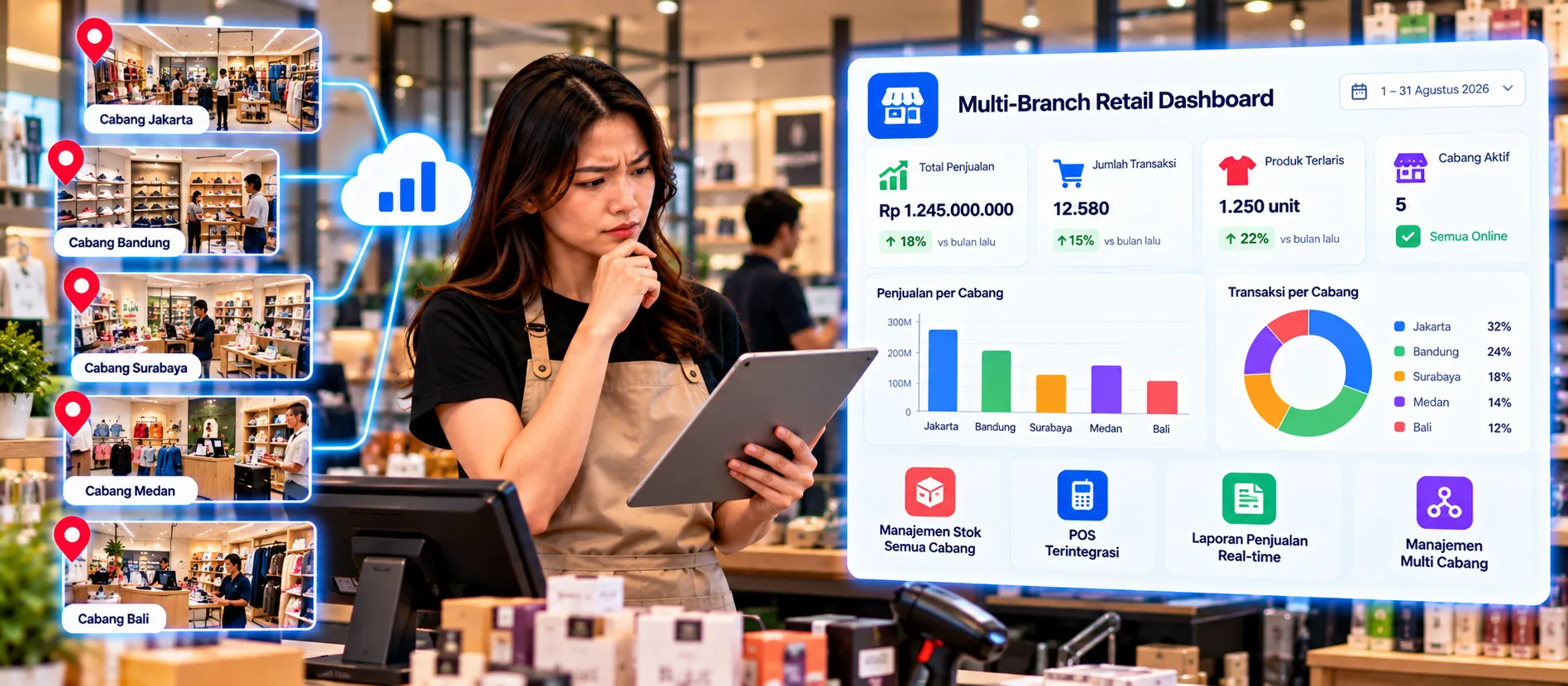
Having five, ten, or even dozens of retail branches can help a business grow, but it also makes monitoring more complex. Management needs to know each branch’s sales, available stock, best-selling products, and even today’s transactions without waiting for manual reports.
The solution is not simply adding more spreadsheets. Retail businesses need interconnected systems. Choosing the right affordable genuine software can help connect transactions, inventory, reporting, and branch operations within a single data flow.
What Software Does a Multi-Branch Retail Business Need?
Point of Sale (POS): Records transactions at each branch.
Inventory Management: Monitors stock and transfers between locations.
Centralized Dashboard: Compares performance across all branches.
Accounting Software: Manages financial data generated from retail transactions.
Choose affordable genuine software that supports multi-location operations, user access controls, reporting, and integrations that match business needs.
1. POS Becomes the Source of Branch Transaction Data
For a retail business, a POS system is more than just a replacement for a cash register.
Each transaction can record the product, quantity, price, discount, payment method, transaction time, and sales location.
If a company has 10 branches and each branch records 200 transactions per day, that means around 2,000 transactions per day need to be monitored.
With POS and affordable genuine software, transaction data can be collected in a more structured way, so management does not need to request manual reports from every branch.
2. Inventory Must Be Visible by Location
Knowing the company’s total stock is not enough.
For example, the system may show that Product A still has 500 units available. But after checking by location:
Branch A: 200 units
Branch B: 180 units
Branch C: 10 units
Warehouse: 110 units
Branch C may be at risk of a stockout even though the company still has plenty of inventory overall.
That is why affordable genuine software for retail should support multi-location inventory.
With affordable genuine software integrated with inventory management, companies can also track stock transfers between branches more clearly.
3. Management Needs a Centralized Dashboard
Management should not have to open ten spreadsheets just to understand the performance of ten branches.
A dashboard can display metrics such as:
Sales Today → Revenue → Transaction Count → Average Transaction → Best-Selling Product → Stock Alert
With a dashboard from affordable genuine software, management can compare branch performance using the same source of data.
Data from affordable genuine software can also help identify patterns. For example, a certain product may sell quickly at Branch A but move slowly at Branch B.
This information can be used to support stock transfer decisions or promotional programs.
4. Set Access Based on User Roles
Not every user needs access to all company data.
Cashiers may only need access to transaction functions. Store Managers may need reports for their own branch. Area Managers may need to compare several locations, while Management needs consolidated reports.
That is why, when choosing affordable genuine software, companies should check whether it provides role-based access control.
Access controls within affordable genuine software help companies limit functions according to each user’s responsibilities while keeping operations practical.
5. Connect Sales with Accounting
Another problem appears when sales data has to be manually transferred into the accounting system.
If every branch sends a report and Finance has to re-enter the data, the process becomes slower and more prone to discrepancies.
Integrating POS, inventory, and accounting can reduce duplicate data entry.
When evaluating affordable genuine software, companies should check whether the system provides APIs, export-import capabilities, or native integrations with other systems already in use.
The more branches a company operates, the more important it becomes for affordable genuine software to support integration so that data does not remain trapped in separate systems.
Software Checklist for Multi-Branch Retail
Make sure the POS supports transactions from multiple locations.
Use an inventory system that tracks stock by branch and warehouse.
Make sure a consolidated sales dashboard is available.
Apply role-based access for each user level.
Check stock transfer functionality between branches.
Choose affordable genuine software that can connect with accounting or other systems.
Evaluate affordable genuine software requirements based on the number of branches, users, SKUs, and transaction volume.
FAQ
1. Does each branch need different software?
No. For centralized monitoring, it is usually more practical to use a system that can manage multiple branches within one platform.
2. What is the most important software for a retail business?
POS and inventory management usually serve as the foundation because they record transactions and stock movements.
3. Can the owner view sales from all branches?
Yes, if the system provides a centralized dashboard and the appropriate access permissions. Management can view consolidated reports without requesting manual reports.
4. What happens if a branch has internet problems?
Check whether the POS system provides an offline mode or local transaction mechanism that can synchronize once the connection is restored. This capability varies by product.
5. Can stock be transferred between branches?
Yes, if the inventory system supports stock transfers. When selecting affordable genuine software, make sure transfer activities have clear statuses and traceable histories.
6. Does POS need to be connected to accounting software?
Not necessarily, but integration can reduce manual data entry and help Finance receive transaction data more quickly.
7. What should be calculated before choosing retail software?
Calculate the number of branches, cashiers, users, SKUs, daily transactions, warehouses, as well as reporting and integration requirements. Based on this data, the need for affordable genuine software can be determined more accurately.
A multi-branch retail business needs more than just a cashier application. Companies need to connect sales, inventory, branches, users, and reporting so that management has consistent visibility across the entire operation.
With an integrated system, management can monitor branch performance without waiting for manual reports, while operational teams can more easily track stock and transactions.
The selection of affordable genuine software should be based on operational scale and integration capabilities.
With affordable genuine software that matches retail requirements, growing the number of branches does not have to make business monitoring more complicated.
Related Articles
Also read other interesting information from us

General
Free Tools to Check Website Responsiveness
Ensuring your website displays well across devices is crucial for providing an optimal user experience. Website responsi...

General
Best Security Software for Freelancers and Remote Workers
Remote workers and freelancers face unique challenges in keeping their data and devices secure. With work activities hea...

General
With Just an Ordinary Laptop, This is the Video Editing Software That Will Make Your Content Viral!
Creating viral content on social media is now the goal of many creators and business people. However, not everyone has a...
Get Free Consultation
Discuss your company's IT needs with our customer support right now at
+62 822 9998 8870


