Article Sep 28, 2026, 06:54 AM
Pay for a License or Bear the Downtime? How to View Software Costs from a Business Perspective
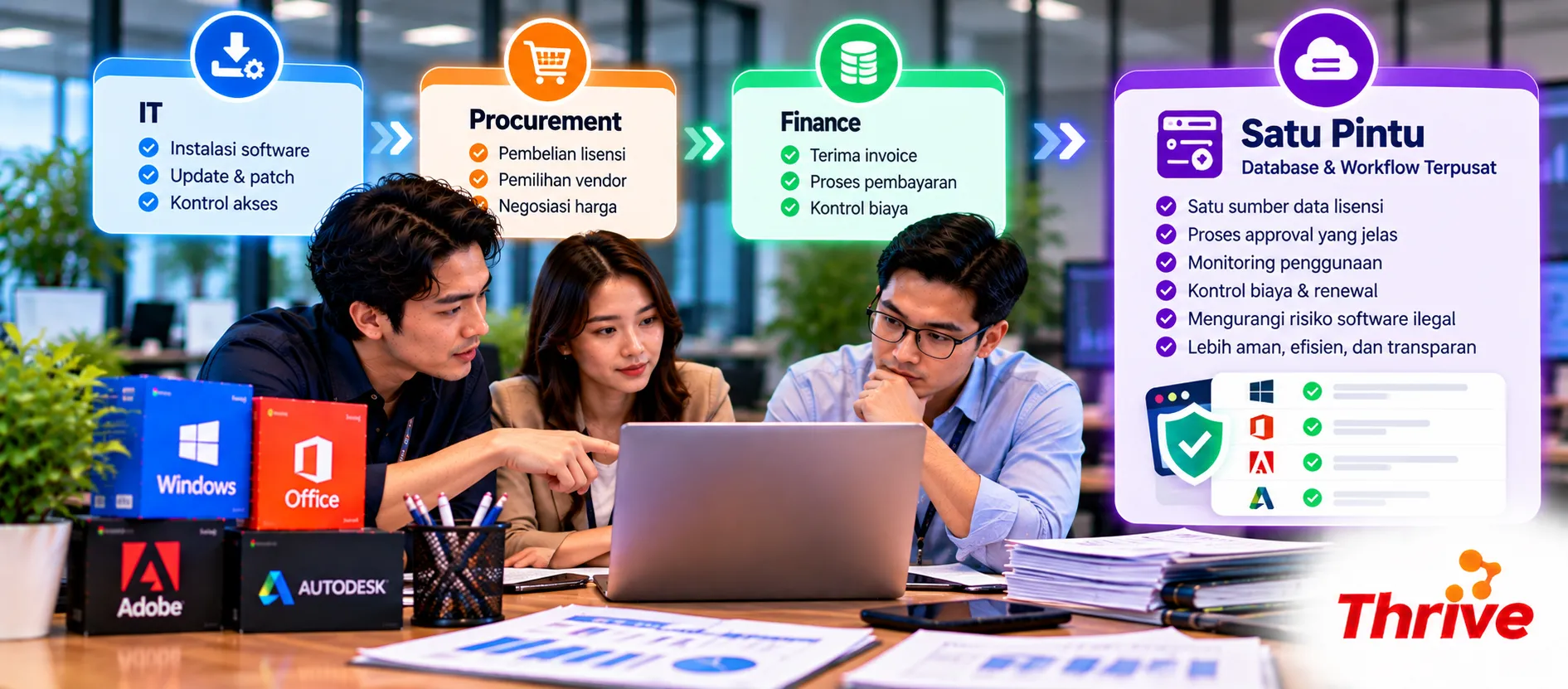
Software licensing costs are often seen as an additional expense. However, from a business perspective, the question is not simply “how much does the software cost?” but rather how much will it cost if the software fails and work comes to a stop?
Purchasing affordable genuine software does require an upfront investment. However, that decision should be compared against the potential costs of downtime, lost productivity, troubleshooting time, recovery efforts, and operational risks throughout the software’s usage period.
Which Costs More: Licensing or Downtime?
1 hour of downtime × 20 employees = 20 productive work hours affected.
If the average labor cost is Rp50,000 per hour, those 20 hours are equivalent to Rp1,000,000 in productivity costs.
The cost of affordable genuine software should be calculated as part of the Total Cost of Ownership (TCO).
Downtime can also affect client service, deadlines, transactions, and daily operations.
For critical software, cost evaluations should cover a 6–12 month period, rather than focusing only on the initial purchase price.
Do Not Evaluate Software Based Only on License Price
In IT procurement, the cheapest option does not always result in the lowest operational cost.
Imagine 30 employees using an application for their daily work. One day, the application experiences an issue and cannot be used for three hours. If the average labor cost is Rp50,000 per hour, the potential productivity cost would be:
30 × 3 × Rp50,000 = Rp4,500,000
This figure does not yet include the IT team’s troubleshooting time or the cost of delayed work.
Therefore, when comparing affordable genuine software, companies need to consider the total cost of usage, rather than simply looking at the license price per user.
Calculate the Cost per Employee
Another simple approach is to calculate the software cost per employee.
For example, if an application costs Rp2,400,000 per user per year, that equals Rp200,000 per month or approximately Rp6,700 per day.
Using this approach, companies can evaluate whether affordable genuine software delivers productivity benefits that justify its daily cost.
If the software helps an employee save 30 minutes of work each day, the efficiency value generated may even exceed the license cost.
Downtime Does Not Simply Mean a Computer Cannot Be Used
The impact of downtime can vary across different business functions.
If design software becomes unavailable, the creative team may be late in delivering materials. If accounting software experiences a problem, invoice processing may be delayed. If a CRM system is unavailable, the sales team may lose access to follow-up information.
This is why selecting affordable genuine software should also consider the business criticality of each application.
The more important an application is to daily operations, the greater the financial impact when it becomes unavailable.
Include the IT Team’s Time in the Calculation
There is another cost that is often overlooked: the IT team’s time.
If an engineer spends four hours troubleshooting, reinstalling, and recovering software, that time represents an operational cost. The impact becomes even greater if the same issue occurs repeatedly.
By using affordable genuine software obtained through a clear and legitimate channel, companies can establish standardized installations, software inventories, and more controlled update processes.
Centralized management of affordable genuine software also helps IT teams track versions, seat counts, active users, and renewal dates without having to start the checking process from scratch.
Use Total Cost of Ownership
The most realistic way to evaluate software costs is by using Total Cost of Ownership (TCO).
In simple terms:
TCO = License Cost + Implementation + IT Support + Downtime + Maintenance + Recovery
Therefore, when evaluating affordable genuine software, companies should not only ask, “How much does each license cost?” but also, “What is the total operational cost over one year?”
This approach makes decisions regarding affordable genuine software more relevant to business requirements and budgeting.
6 Figures to Calculate Before Buying Software
Calculate the number of users who genuinely need the application.
Determine the license cost per user per month or per year.
Estimate the cost of 1 hour of downtime for the relevant team.
Record the average troubleshooting and recovery time.
Compare those costs with the price of affordable genuine software over a 6–12 month period.
Review the use of affordable genuine software regularly so the company does not continue paying for unused seats.
FAQ
1. Is a software license always cheaper than downtime?
Not always. The value depends on the license price, number of users, application function, and the impact of downtime on the business. Therefore, the calculation should be based on the company’s actual conditions.
2. How do you calculate the cost of downtime?
Use a simple baseline:
number of affected employees × downtime duration × labor cost per hour
For a more complete calculation, add IT support costs and potential operational losses.
3. What is Total Cost of Ownership?
TCO is the total cost incurred throughout the period in which the software is used. It includes not only the license price, but also implementation, maintenance, support, downtime, and recovery costs.
4. Does genuine software guarantee zero downtime?
No. Affordable genuine software can still experience errors or disruptions. However, clear and legitimate licensing helps companies establish more structured processes for updates, standardization, and software management.
5. How can you determine whether software is worth purchasing?
Compare the cost with the business benefits it provides. Calculate the time saved, productivity gains, user requirements, downtime risks, and the application’s role in business operations.
6. What if only some employees need the software?
There is no need to automatically purchase licenses for every user. Conduct user mapping first, then adjust the number of affordable genuine software licenses according to actual requirements and the vendor’s licensing terms.
7. How often should software costs be evaluated?
Ideally, they should be reviewed at renewal or at least every 6–12 months. Check the number of active users, unused seats, price changes, and current business requirements before renewing the company’s affordable genuine software.
Software should not be viewed solely as a procurement expense. For businesses, software is part of the working infrastructure and has a direct impact on productivity and business continuity.
Therefore, the decision to purchase affordable genuine software should be compared against the potential cost of downtime and the operational expenses incurred throughout its use.
By applying a TCO approach, companies can select affordable genuine software based on the business value it delivers, rather than simply choosing the option with the lowest upfront price.
Related Articles
Also read other interesting information from us

General
How to Maximize Your Website for Effective Marketing Without Breaking Your Budget
Memiliki website yang efektif dan berfungsi optimal sangat penting dalam menjalankan strategi pemasaran digital. Namun,...

General
Common Mistakes When Using Cloud Storage
Cloud storage has become a primary data storage solution, especially for businesses that require flexibility and easy ac...

General
Managing Business Taxes is Easier with Accounting Software
Managing business taxes is often a challenge for many entrepreneurs, especially as transaction volume increases and tax...
Get Free Consultation
Discuss your company's IT needs with our customer support right now at
+62 822 9998 8870


